The book
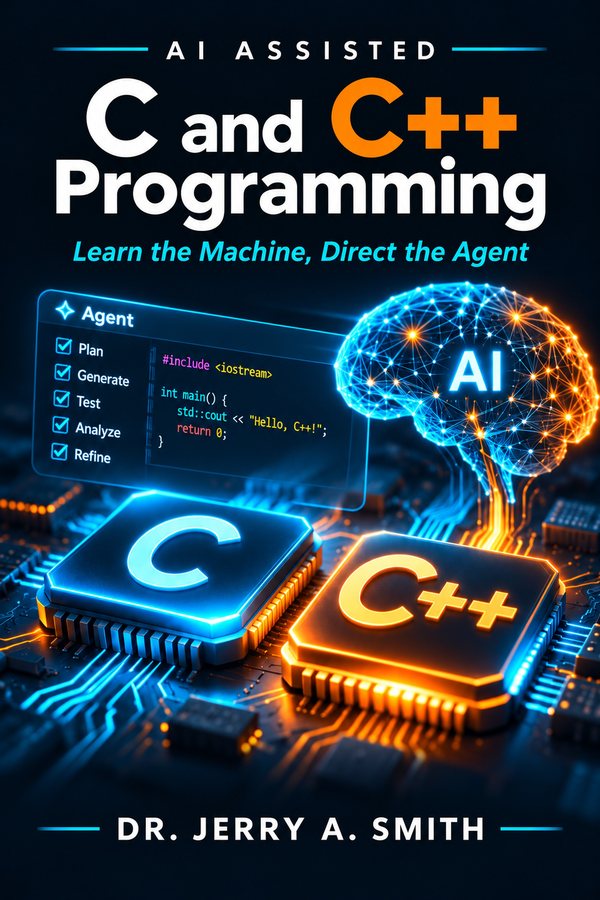
AI Assisted C and C++ Programming
Learn the Machine, Direct the Agent. By Dr. Jerry A. Smith.
Paperback on Amazon: coming soon Kindle: coming soon
- Pages
- 792, 6 × 9 in
- Paperback ISBN (Amazon)
- 979-8-1646-5533-4
- Paperback ISBN (bookstores and libraries)
- 979-8-1829-7631-2
- Publisher
- VVG Publishing, 2026
- Languages
- C17 and C++20
From the preface
A coding agent can now write the first assignment of a C course faster than a student can read the assignment. It can write the second one too, and the tenth. The programs compile, they pass the tests an instructor would write in week three, and many of them are correct. I wrote this book because of what that does to the meaning of a working program.
When I sat down to plan the programming course I had agreed to teach, I gave the first assignment to a coding agent before I gave it to anyone else. It came back in under a minute: tidy, commented, free of warnings, and passing every test I had written for it. The question I asked myself was not whether the program was right. It was what a grade on that program would tell me about the student who turned it in.
Contents
Front matter: Preface · How to Use This Book · Setting Up Your Workbench.
- Part I. Foundations
- Part II. C and the Machine
- Control Flow, Functions, Recursion, and Counting Operations
- Pointers
- Arrays, Strings, and Matrices: n, n², n³
- The Stack and the Heap: Dynamic Memory and Ownership
- Structs, Headers, and Multi-File Programs
- Growable Arrays and Linked Lists: The Cost of Growth
- Files, Bits, and Function Pointers: ADTs Behind a Header
- Part III. Cost and the First Delegation
- Part IV. C++ and Objects
- Part V. Generic Code, Data Structures, and Agent Teams
Back matter: Appendix A, Audit Report Template · B, Agent Traps by Chapter · C, Tutor Prompt and Prompt Patterns · D, Sanitizer, Valgrind, and gdb Card · E, Work-Log Template · F, Oral-Defense Question Bank · G, PAs and Labs at a Glance · Glossary · Bibliography · Index.
The book's sibling is AI Assisted Software Engineering by the same author.